Sunday, May 25, 2008
Emergent behaviour

Fractal origami
You know when you get a word that just sort of sticks in your head and you can't figure out where it came from or what it means? I had this the other day with the word 'tesseract.' I could not figure out why it had wormed its way into my brain or what it meant, but my friend Adam and I speculated that it probably had something to do with tessellation, the kind of repeating of part of an object over and over to make a pattern.
When I got home I wikipediaed the word and got even more confused. The way it explained it is this: if you have a line and you want to make it into a square, you move out at perpendicular angles from it until you make a closed object. Right angles. And if you want to make a cube, you move out at perpendicular angles from the vertices of the square until you make another closed object, which is now in three dimensions. Okay, so apparently a tesseract is what you get if you make the same movement out from a cube. It can look like a cube inside a cube... or sometimes not. Confused? So was I. But it got me thinking about this very basic idea that extraordinarily (and sometimes mystifyingly) complex things can arise from the extension of very simple principles in a system.
Which is kind of the basic idea between a field of science I've been sort of captivated at a distance by for years: emergence. Emergence is the study of the complex behaviours of systems arising from the simple, sometimes even stupid behaviours of individuals making up the system as a whole. A good example is the way a colony of ants behave.
 On their own, ants can be pretty dumb. Out foraging for food (and I've never studied ants, but this is my understanding of this thing), ants put their little antennae up to smell for anything of interest, but they're just kind of running around every which way, back and forth, in a way that looks pretty random to an observer. And then, it turns out, when they run into something good, they lay down a pheromone trail that lets other ants know which way to go to find it.
And when a a second ant bumps into this pheromone trail, catches that tasty tasty scent and follows it, it lays down its own chemical trail, amplifying the effect for the next ant and the next ant and the next ant. Before you know it, these little hiking trails become big ant super highways. This is the kind of thing I've heard described as 'architecture through error.' It's not planned, it's not coordinated by some director, and if you looked at each individual ant to try to extrapolate some picture of what this pheromone gland might be used for, a food superhighway wouldn't necessarily be intuitively obvious. But it works.
This is the same kind of thing that's going on in your brain. You can't look at a neuron and see a memory. Just holding up one cell, it'd be impossible to find where love is located, or a fear of sea urchins. But when you get an eight and a half pound ball of neurons all firing together, you get emergent properties that are pretty incredible. Emergent behaviour is behind the exponentially more accurate guesses a crowd makes the more people there are guessing, behind the surprising accuracy of articles written by thousands of amateurs on Wikipedia... it's everywhere.
If you want to learn more about it, I recommend:
- This episode about emergence from Radiolab, a show out of WNYC in New York. It's brilliant. You'll get a kick out of it, and who wouldn't love a co-host with a name like Jad Abumrad?
- This website called Exploring Emergence, where you can play around with little games that show how simple rules like 'pixel on,' 'pixel off' can make some craaazy crazy things.


Monday, May 12, 2008
Podcast #2
 Where on earth has he been, the masses cry. Calm down, my adoring fans. Your letters have filled my new mailbox (I moved across the street last week) to bursting, and I simply haven't the time to write back individually. I
've been working on episode 2 of the podcast, you see. It's quite a cracker. This episode features a riveting discussion about Paulo Freire and mixed martial arts. What's that I hear in the distance? Ah yes. The sound of riveting. Ness.
In case you can't get enough of the music (and who could?), here's the track listing for your listening convenience:
00:28 La Ritournelle (Mr Dan's Magic Wand Mix) - Sebastien Tellier
03:47 World Town - M.I.A.
33:07 Possibly Maybe - Final Fantasy & Ed Droste (download this whole album for free at Stereogum here)
51:47 Making of a Cyborg - Kenji Kawai
56:19 The Shore - Basia Bulat
You can download it here, subscribe on iTunes now (yay! just search for The Subject Tonight) or listen to it steaming below. Questions and grave concerns are, as always, more than welcome. Kudos to last year's contest winner and all around lovely young woman Jenanne for the Basia Bulat track, taken from a CBC Radio 3 concert. I was searching for that song for a long long time.
Photo credit: Shiratski (published under a Creative Commons licence)
Labels: education, ideas, music, podcasting
Wednesday, December 26, 2007
Another thought

"Not all possibilities are open to us. The world is finite - our hopes spill over its brim."
Salman Rushdie, The Satanic Verses
Labels: ideas
Saturday, December 22, 2007
While you're at it
A free idea today, to whoever'll take it and run with it (or maybe you've already gotten started on it). Every year up here in the sort of (but not permanently) frozen north, we complain until our faces turn blue about potholes. It's an absurd way to talk about city budget priorities, but it's true; frost heaves pull apart the road every single year, and every single year we spend an awful lot of money fixing them so nobody falls in, plunges over a cliff, trips, etc.
But if we were to look at the design requirements for a road, what would they be? A level surface. Something that grips. Easily lay-downable. Nothing in there about needing to use an impenetrable material that irreparably cracks and splits every time the ground freezes. Maybe irate writers to editorials all across this country are onto something. Why not look for other types of materials - surfaces that don't flood all the rainwater running over them into stormdrains, surfaces that don't break apart with the ice. There's a place for this beside the people working on crosswalks that light up along the ground when you've got the right of way.
Who's working on this?
But if we were to look at the design requirements for a road, what would they be? A level surface. Something that grips. Easily lay-downable. Nothing in there about needing to use an impenetrable material that irreparably cracks and splits every time the ground freezes. Maybe irate writers to editorials all across this country are onto something. Why not look for other types of materials - surfaces that don't flood all the rainwater running over them into stormdrains, surfaces that don't break apart with the ice. There's a place for this beside the people working on crosswalks that light up along the ground when you've got the right of way.
Who's working on this?
Labels: ideas, sustainability
Friday, December 21, 2007
B.S.F, Edition #1

Groooooss. Algae picture courtesy of the Lake Doctors Inc, apparently.
It seems like an appropriate moment to bring you the first edition of the B.S. Files on this blog. As an Albertan who was reluctantly-so for many years and has lived in a few different parts of our home on Native land (did I say that?), I try to have a generous heart when thinking about the things my fellow Canadians say and do. Sure, people from Toronto often seem incredulous to hear Edmonton's got a hip hop scene (or black people), but then again, we Edmontonians have a dim sense in general about things like, well, like the fact that in Toronto or Montreal, multiculturalism doesn't just mean having a black kid at the back of the class.
There must be something strange going on in Ontario since I've been away, though. A toxic bloom of algae on Lake Superior that went unnoticed for months, until it'd made some brains over there sufficiently addled to chuck reason or common sense completely off their mental bookshelves. How else to explain Harper's gushing, smirking, self-satisfied explanation in slow and small words to Peter Mansbridge last night that Canadians were going to be really, really upset when they started seeing that it was going to cost money in the short term to reduce our greenhouse gas emissions? Was it just my imagination, or did Nicholas Stern really publish a report last year that outlined very clearly and specifically the billions of dollars more in costs we would incur in the decades to come if we chose not to act on climate change immediately? I was under the impression that this was a fairly definitive statement that yes, doing things now are going to cost a lot of money, but a hell of a lot less than waiting until 2020 to achieve insultingly inambitious almost-reductions. Pretty sure that was all cleared up. Why are we still talking about this?
Also on the algae file: the Halton Catholic School Board, and their absurd decision to ban Philip Pullman's His Dark Materials trilogy from their libraries. As if it weren't humiliating enough that it took them about a decade to notice the books were on their shelves, one might imagine an organ of a body with such a long and storied history of banning and burning things like the Catholic Church might have realised by now that taking a book off your shelf won't make the ideas in it go away. The board said in its decision that the books are not in keeping with 'the Catholic values that we are trying to teach children.'
They're right, of course. Absolutely. The books quite definitively take aim against some of the most cherished and fundamental tenets of Christianity. But come on. Yes, it's an outrage that the school board has so little respect for the critical thinking skills of the kids in their schools that they seriously believe that students are a) incapable of making up their own minds about what's in the books and b) stupid enough to not realise the books exist or go find them if they're not on the shelf at school. But more outrageous is that the board is clinging to a belief that was long ago bludgeoned, bloodied, pepper-sprayed right in the eyes, and shattered into tiny pieces of intellectual shame: that hiding ideas makes them go away at all.
When really revolutionary thinkers go about challenging dangerous or deeply-held beliefs, they don't hide the old beliefs away or burn them, they come up with new and compelling ways of seeing things. To a small number of confused and terrified people's surprise, it works. Darwin didn't need to burn copies of the Torah to get people to believe our history stretches into unfathomable depths of time, times when our hairy little ancestors bore very little resemblance to Sun Yat-Sen or Shaq or Diana Ross at all. Apple didn't need to start locking up people's CD players to convince us that a pretty little mp3 player was a very, very useful thing. To really present a fierce challenge to an idea, you don't ban it. You argue about it, you refute it, you hold it up critically and show that what you're holding in the other hand is a whole lot better.
The failure to realise this is probably much better explained by Naomi Klein, of course, in The Shock Doctrine. But I haven't read enough of it to learn much more than the 8-minute Alfonso Cuaron movie they put out about it, so I'll come back another day to her thesis about modern capitalism's inability to seriously assert itself as a global ideology without banning or burning the ideas that oppose it - through state terror, international financial blackmail, you know. The usual.
Labels: algae, bsf, environment, ideas, literature, schools
Monday, January 29, 2007
Contest this!
 I am officially announcing the first-ever photo contest here on The Point. In less than a month I will be taking a hiatus for a while, so this is my little way of saying thank you for reading.
The rules are: send in a picture that shows why the place you live is great. I will be selecting on the basis of charm, bravado, hilarity, and/or (for good measure) poignancy. This does not mean you have to send in a picture of a sign that says 'City of Champs.' Be brave. Be tremendous. Send in as many entries as you like.
The winner will (obviously) get their picture featured on this blog as well as a copy of any book I have talked about here (except Worldchanging, I do not intend to spend my entire tuition on postage) and a personalised handy-dandy reading list that will be good for your soul. You get to pick the book. Reading this blog every day over your granola is not required to enter.
The contest ends Sunday, February 11th at 11.59 Mountain Standard Time. Send your pictures to
 . If there are a lot of really good ones, maybe I'll do a retrospective or something.
Can't remember all the books? Click here.
UPDATE: Deadline extended to 11.59 pm on Wednesday, February 14th. Because we are lovers.
Wednesday, January 03, 2007
I am not a fish
| I hate using Google Video because it seems way too complicated, not as fun, it pauses more often for no reason, and I don't understand why it still exists since they now own YouTube anyway. But I am exploiting their generously offered service to post for your enjoyment a clip of the most brilliant finger-on-the-pulse-of-the-zeitgeist guy I've found on the internet: Seth Godin. Read his blog, follow his links, and watch things magically cascade into place all around you. This is Seth at the Gel Conference 2006 on Things That Are Broken. | |
Labels: ideas
Wednesday, November 08, 2006
Some bright ideas
 I wonder where I'm going to end up in the next ten years. I made a list the other night of all of the half-way things I've been or aspired to be in the past year or so. They have included: a poll clerk, a tutor, a youth educator actor sort of person, an amateur journo, a poet, a support worker, a dreamer of places and ideas, and a recluse. Among other things.
One thing I have dreamed deeply about is my city. Being away from it for a while gave me some fresh perspective when I came back this year, and I have learned to love the place I'm from in all its slushy white and brown glory. I know cities are much maligned these days as alienating places, sometimes dangerous, sometimes incubators of poverty, sometimes cruel. These things are true. But there are also strange accidental beauties to this small place that I am from, and reading a bit of Jane Jacobs this fall has given me some hope.
The Death and Life of Great American Cities was published in 1961, while Jacobs was living and learning New York (and much before she became a Torontonian of the best kind in my favourite 416 neighbourhood, the Annex). Many of the ideas in the book seemed at once new and obvious to me, as if these were things I should have intuitively known about how big North American cities work if only I'd been more observant. And yes, while it is about American cities, every one of these ideas resonates with me here in Edmonton, land of the Mill Woods sprawl.
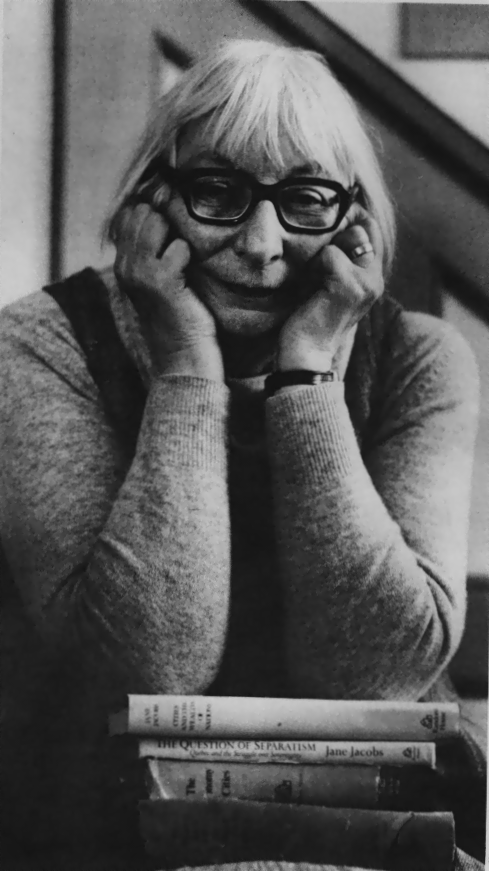 She talks about the conditions that create diversity, which she considers the great bringer of life and health to communities. Jacobs was a great admirer of spontaneity, of the casual meetings of neighbours and strangers on sidewalks and in cafes that lend great cities their ability to be hosts and midwives to the birth and growth of new ideas and fresh perspectives. For her, these things couldn't be planned, only allowed room to grow and to change and to fold over and into one another. I am learning, I guess, that the strength of a community cannot be legislated, although it can be legislated out of existence.
Walking through my now chilly south side neighbourhood, I walk past tall apartment towers mingled with low-rise condos and old, inviting homes with what my friends Norm and Joanne have called 'public rooms,' those kind of porches you can sit and have coffee on and say hello to your neighbours from, watch your kids play from, participate in the life of a street from, and I wonder how she could have known so much about what makes my neighbourhood great 45 years before this moment. She had great admiration for the role of streets in cultivating relationships, in allowing new and creative uses and experiences to emerge. I would truly have liked to have taken her around Strathcona and shown her our cafes, our restaurants, our sidewalks (and lack thereof, in places). What would she have said?
I guess it's immaterial. What makes this city great is not just the river valley, or the bridges, or the Listen birds, or the pyramids being put up and torn down. It is the people. And the people here are a strange wondrous bunch.
I'm going to get to know them better, friends.
Labels: books, cities, communities, ideas, sustainability

This work is licensed under a Creative Commons Attribution-Noncommercial-Share Alike 3.0 Unported License.
aside

A blog about books, ideas, Canada (or lack thereof) and more. We've got more RPMs than a Latin American history DVD.
Previous Posts
Archive
- May 2006
- June 2006
- July 2006
- August 2006
- September 2006
- October 2006
- November 2006
- December 2006
- January 2007
- February 2007
- August 2007
- September 2007
- October 2007
- November 2007
- December 2007
- February 2008
- March 2008
- April 2008
- May 2008
- June 2008
- July 2008
- August 2008
- September 2008
- December 2008
- February 2009
- July 2009
- May 2012

Links
- Money Undressed
- Seth's Blog
- 中外对话|China Dialogue
- mental volumes with vasyL
- How to Save the World
- daveberta
- Ugandan Insomniac
- This American Life
- Life as a Vole
- Kate Beaton comics
