Sunday, April 06, 2008
Omop.
One of the issues they talk about in constructing as it's conventionally done today is that we mix substances that could otherwise be recovered and reused usefully. A shoe with leather parts that can literally become food for other organisms within our ecosystem has become a shoe with those parts mixed in with plastics that could be broken down into something new, with rubber and toxic additives, so that none of those components can be separated usefully once the shoe has is worn out. To appropriate a word coined by Jane Jacobs, they become monstrous hybrids. Well, theDieline.com does a blog with a couple daily reviews of excellent packaging design, and one of the submissions posted by the people at Sustainable is Good is this great example of a package that takes this into consideration: Method's "Omop" mop set.
 TheDieline.com writes:
Made specifically for Method from a combination of paper and bamboo the new brown packaging has an attractive unfinished quality to it - totally unique next to other products packaged in clear clamshells with bright labeling.So there you go. Something brilliant to start your day (or end it) with.The packaging has a minimal quality to it that alone provides it a creative advantage - you want to look at the packaging, touch it and find out what is in it.
The packaging is both compostable and recyclable (mixed paper) and its creation has an interesting story behind it.
The idea for the new design came out of a "Design Safari" a regular creative departure held internally among Method staff. At the safaris staff members share examples of packaging or creative design they like and discuss it with their colleagues.
The new Omop starter kit packaging is compartmentalized. Everything has its own place in a logical easy to open format (unlike many clamshells).
Labels: blogs, design, sustainability


Saturday, February 23, 2008
I turn my back for one minute...
A mediocre showing of candidates in Edmonton-Strathcona I am disappointed, but not surprised, about. It's nice to know Raj has a feisty successor in NDP candidate Rachel Notley, who actually seems to have thought carefully about what she would do in the legislature beyond thumbing through her party's platform. But the Liberal and Conservative candidates... Tim Vant really couldn't remember if the Liberals support putting a stopper on any new oil sands development immediately or not? And kudos the PCs for finding a sacrificial lamb after all, but TJ Keil sounds less and less informed every time I read about something he's said. Thank you to terahertz for blogging the all-candidates forum (minus Green candidate Adrian Cole) and making my decision very very easy.
What I did not anticipate in this election was the extent to which the PCs' shamefully lazy sense of entitlement would apparently lead them to think they could just rig this election anyway they please:
That's right. Half of the returning officers in the province have "strong ties with the Progressive Conservatives." If you're going to rig an election, do it with class, man! Does Stelmach really think the "optics" of this are going to get any better for having appointed Katherine Harris as Chief Returning Officer - Harris of Florida's cheery hanging chad fame? (Kudos to Calgary Grit and to Dave Cournoyer of daveberta, who is a very nice fellow and a decent tipper, which is an important thing)
My province, my province... I leave for one semester and suddenly we've got all the usual apathy of an Albertan election compounded with the absurd electoral shenanigans of Putin and the gang?
Fortunately one province out west doesn't seem to have completely lost their minds... BC has been moving to reduce their greenhouse gas emissions by over 30% from 2007 levels by 2020, and they've actually got a plan to do it - starting with a carbon tax! Which is reasonable, since by 2006 their emissions had gone up by 30% over 1990 levels. Crazy. It's happening.
Labels: alberta, bc, democracy, politics, sustainability
Saturday, December 22, 2007
While you're at it
But if we were to look at the design requirements for a road, what would they be? A level surface. Something that grips. Easily lay-downable. Nothing in there about needing to use an impenetrable material that irreparably cracks and splits every time the ground freezes. Maybe irate writers to editorials all across this country are onto something. Why not look for other types of materials - surfaces that don't flood all the rainwater running over them into stormdrains, surfaces that don't break apart with the ice. There's a place for this beside the people working on crosswalks that light up along the ground when you've got the right of way.
Who's working on this?
Labels: ideas, sustainability
Wednesday, January 10, 2007
Persuasion
 I just picked up the stellar (but almost star-like in weight) WorldChanging book, a print offshoot of the brilliant Worldchanging.org website and pretty much a compendium of some of the ideas that excite me most about the world we are wandering into these days. I hadn't planned on picking it up, actually, but Audrey's tempted me with their cursed 30% Off 30 Books propaganda and I couldn't resist.
Essentially it's a very pretty encylopedia of 'world-changing' ideas circulating in our world today. The Al Gore foreword is an interesting addition, although a direct connection to the buzz about An Inconvenient Truth is a little tenuous. While it deals a lot with practical, cool solutions being tried out around the world to address climate change, it is as much about participatory change, about becoming the revolutionary, as it is about icecaps and lightbulbs. (Incidentally [especially to my North American and European readers], if you're not using compact fluorescent lightbulbs yet, why not? MisEntropy comments here.)
Ideas range from pay-before-boarding bus stations in Curitiba (to make taking their amazing high-speed bus system easier and more convenient) to culturally appropriate and portable LED light sources for Huichol tribes in Mexico. There's lots of delicious eye-candy for design junkies, including pictures of a LEED-certified skyscraper (the highest international standard at the moment for environmentally sustainable and smart design) in Singapore, which I pored over for ages. It even talks about Huangbaiyu, as well as other villages in China 'green' building ideas are being tested out in.
 As a compendium of ideas, it does tend to gloss over drawbacks in some of the projects it describes. About the hyper-cool Dongtan district being built in Shanghai to be walk/bike/bus-able, energy self-sufficient and almost completely independent in food production, for example, it ignores the likely impossibility of any of Shanghai's ample population of poor and migrant workers to afford housing in the area. I don't believe in any capacity that sustainability is the exclusive domain of the rich; it's a contradiction in terms.
As well, it talks a lot about cradle-to-cradle design, which made my heart all aflutter, but has some contradictions in how it talks about those ideas. In some sections it ramps up how groundbreaking and obvious designing things beyond a single lifetime is, but in others it unduly celebrates a culture of reducing, of efficiency, and of minimising bad instead of fostering a brand new (and brand old) good.
These things are easily overlooked, in my opinion, given the sheer volume of fascinating ideas. Not a cheap tome, but the thoughts within are a bargain. Keep in mind I'm trying to read this at the same time as Margaret Somerville's The Ethical Imagination, Carol Off's Bitter Chocolate, Kiran Desai's The Inheritance of Loss, and make a dent in M G Vassanji's The In-between World of Vikram Lall. And learn Chinese.
It excites me because a year ago, a 'big' conversation in our society about changing the way we live would have been... not unthinkable but probably laughable. Something tells me change is in the air, and I want to get in on it.
A note: In my last post, I falsely implied a direct link between Novartis' lawsuit regarding one of its drugs, Glivec, and access to HIV/Aids drugs in India and throughout the Global South. In truth, Glivec is primarily a cancer-fighting drug, but Oxfam gives an analysis here of the probable impact of a successful lawsuit on Novartis' part on production of other generic drugs in India's booming industry. New patent laws there have created quite a bit of controversy, apparently. Read up.
Photo credit: Kit Seeborg (see, Amazon is good for some things) and Edward Burtynsky
Labels: books, design, sustainability
Friday, December 29, 2006
What to watch: 2007
 Björk in snow (bjork.com/Erez Sabag)
Three things to watch in 2007:
Björk's new album - I am waiting with great anticipation for her new record. Her last stand-alone album, Medúlla, successfully caught everyone listening by surprise, to say the least. I appreciate that she doesn't sing for the sake of reaching as many people as possible. Some people want to listen to her experimenting with making beats out of cards shuffling and throat singing; others do not. For those of us that do, so much the better, because she's a brilliant (if bizarre) artist through and through. Now she's apparently working on a hip-hop album of all things. How can you say no to this woman? She's insatiable. The best part? She's reportedly producing it with Timbaland. Yes yes yes.
Darfur and Jan Eliasson - The genocide that wouldn't go away. Kofi Annan just appointed Jan Eliasson, former President of the United Nations General assembly and former Swedish foreign minister, as the Secretary-General's Special Envoy in Darfur. It's way past the point of humanitarian collapse. Aid agencies are pulling out after facing '"unprecedented difficulties" because of military activity and direct violence against them.' Sudanese President Omar Hassan al-Bashir has conditionally accepted a joint UN-African Union peacekeeping force in the region, but has intimated the government may allow little more than logistical support from the UN troops, and only a few hundred of them at that (as opposed to at least 22 000 troops in the joint force that many many corners are saying are urgently needed).
It is an understatement to say that there is something of a conflict of interest here. Why on earth al-Bashir's government, who have been accused of complicity in the genocide themselves, should have the final say in whether UN forces are allowed into the region to bring an end to the slaughter... is simply beyond me. It's absurd. Let's see how closely Ban Ki-moon listens to Eliasson in the new year and whether the international community has the balls to finally act.
Huangbaiyu - On this little village rest the hopes of a nation. Sort of. Despite what the Kyoto Accord might imply, there can be no discussion of creating sustainable societies today without China and India, and the former is taking an ambitious step in a tiny community in Liaoning called Huangbaiyu. William McDonough is the co-author of Cradle-to-Cradle, a book about truly circular ways of living in a very nutritious way which you can expect to hear a lot more about here and which you should pick up now. He's also part of the China-US Centre for Sustainable Development, which recenty launched a project in Huangbaiyu to create more sustainable homes for the residents, taking into account the cradle-to-cradle concept of making things that are locally appropriate, use energy intelligently, and give net benefits to the environment they are part of. The problem? It seems no one asked the residents about the project.
Locals are complaining that the new homes have yards that are way too small to support the small home-based agriculture they depend on to supplement their income, and are far too expensive. So far, not a single one of the 42 homes built in the first phase of the project has any takers. Part of the problem is likely that the 'local partner' in the project, Dai Xiaolong, is the village's leader as well as a chief investor. An experienced businessman, he should be commended for pursuing environmental sustainability for his community for more than just altruistic reasons - after all, no company is going to invest in something for the benefit of society as a whole if it's not going to make them a profit. It seems the project has taken a series of bizarre turns, though. Only one house is solar-powered as planned, the building materials being used aren't at all what was originally envisaged, the houses are apparently being built with garages...
It reminds me, actually, of the lack of consideration of the needs of the actual residents that seems to be threatening the veneer of 'sustainability' over Edmonton's Downtown East plan. It will be well worth watching what happens in Huangbaiyu next year, because the number of fingers in this particular pie means what happens in Liaoning will likely help set the tone for other sustainable development projects in the Middle Kingdom.
Labels: genocide, music, sudan, sustainability
Wednesday, November 08, 2006
Some bright ideas
 I wonder where I'm going to end up in the next ten years. I made a list the other night of all of the half-way things I've been or aspired to be in the past year or so. They have included: a poll clerk, a tutor, a youth educator actor sort of person, an amateur journo, a poet, a support worker, a dreamer of places and ideas, and a recluse. Among other things.
One thing I have dreamed deeply about is my city. Being away from it for a while gave me some fresh perspective when I came back this year, and I have learned to love the place I'm from in all its slushy white and brown glory. I know cities are much maligned these days as alienating places, sometimes dangerous, sometimes incubators of poverty, sometimes cruel. These things are true. But there are also strange accidental beauties to this small place that I am from, and reading a bit of Jane Jacobs this fall has given me some hope.
The Death and Life of Great American Cities was published in 1961, while Jacobs was living and learning New York (and much before she became a Torontonian of the best kind in my favourite 416 neighbourhood, the Annex). Many of the ideas in the book seemed at once new and obvious to me, as if these were things I should have intuitively known about how big North American cities work if only I'd been more observant. And yes, while it is about American cities, every one of these ideas resonates with me here in Edmonton, land of the Mill Woods sprawl.
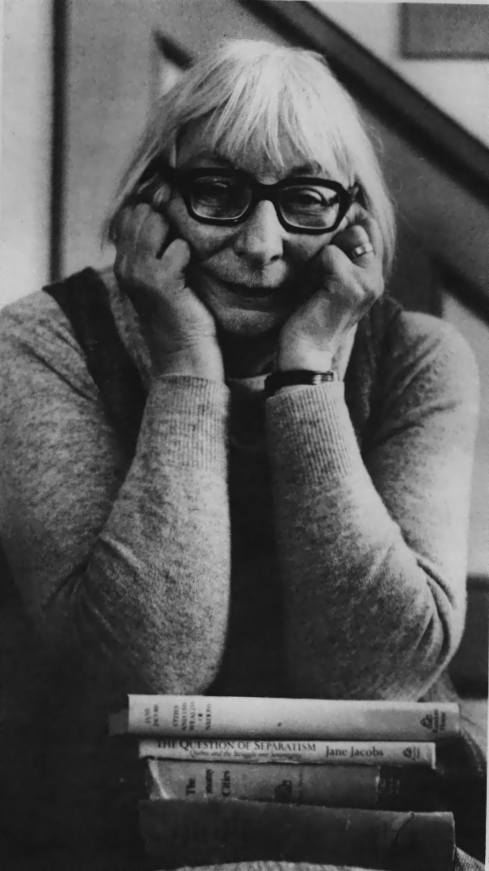 She talks about the conditions that create diversity, which she considers the great bringer of life and health to communities. Jacobs was a great admirer of spontaneity, of the casual meetings of neighbours and strangers on sidewalks and in cafes that lend great cities their ability to be hosts and midwives to the birth and growth of new ideas and fresh perspectives. For her, these things couldn't be planned, only allowed room to grow and to change and to fold over and into one another. I am learning, I guess, that the strength of a community cannot be legislated, although it can be legislated out of existence.
Walking through my now chilly south side neighbourhood, I walk past tall apartment towers mingled with low-rise condos and old, inviting homes with what my friends Norm and Joanne have called 'public rooms,' those kind of porches you can sit and have coffee on and say hello to your neighbours from, watch your kids play from, participate in the life of a street from, and I wonder how she could have known so much about what makes my neighbourhood great 45 years before this moment. She had great admiration for the role of streets in cultivating relationships, in allowing new and creative uses and experiences to emerge. I would truly have liked to have taken her around Strathcona and shown her our cafes, our restaurants, our sidewalks (and lack thereof, in places). What would she have said?
I guess it's immaterial. What makes this city great is not just the river valley, or the bridges, or the Listen birds, or the pyramids being put up and torn down. It is the people. And the people here are a strange wondrous bunch.
I'm going to get to know them better, friends.
Labels: books, cities, communities, ideas, sustainability

This work is licensed under a Creative Commons Attribution-Noncommercial-Share Alike 3.0 Unported License.
aside

A blog about books, ideas, Canada (or lack thereof) and more. We've got more RPMs than a Latin American history DVD.
Previous Posts
Archive
- May 2006
- June 2006
- July 2006
- August 2006
- September 2006
- October 2006
- November 2006
- December 2006
- January 2007
- February 2007
- August 2007
- September 2007
- October 2007
- November 2007
- December 2007
- February 2008
- March 2008
- April 2008
- May 2008
- June 2008
- July 2008
- August 2008
- September 2008
- December 2008
- February 2009
- July 2009
- May 2012

Links
- Money Undressed
- Seth's Blog
- 中外对话|China Dialogue
- mental volumes with vasyL
- How to Save the World
- daveberta
- Ugandan Insomniac
- This American Life
- Life as a Vole
- Kate Beaton comics
