Tuesday, June 17, 2008
Forty-nine days


Wednesday, March 05, 2008
Apropos d'Afrique
- Fiction (novels, short stories, poetry, drama)
- Memoir / autobiography
- History and current events
 Tandia - Bryce Courtenay
 This novel's predecessor, The Power of One, changed my life. Keeps echoing. I've been avoiding the sequel - also set in South Africa and co-starring Peekay - for some reason, but now that I have a copy of Tandia at home and have been implored to read it by someone whose reading list I admire greatly, I have no excuse.
 28: Stories of Aids in Africa - Stephanie Nolen
I really love Nolen's work as the roaming Africa correspondent for the Globe and Mail, and I've heard a lot of good things about this book. She somehow managed to get a blurb from Stephen Lewis for this non-fiction collection of honest, humanising stories, which is all the endorsement I need.
 Searching - Nawal el Saadawi
 When we read another one of this Egyptian author's books (Woman at Point Zero) in high school, I admit I was pretty sure I'd never read another one of her books again. Too dark, too heavy. A good friend of mine and the host of Put 'Er in D for Dangle on Tuesdays on CJSR back at home gave this novel to me recently though, and I think I'm ready to give her another try. Don't know anything about it, but I'm ready to explore.
 The Search - Naguib Mahfouz
 Another muy famoso Egyptian writer. I've had a bookmark in this short novel for a while, but haven't picked it up in about a year. I do remember it takes place in Alexandria sometime in the early (?) 20th century and had a sort of disorienting tone to it. See any themes emerging in how I've been picking these yet?
 The Anti-Politics Machine - James Ferguson
 This study of development experiences in Botswana about the tendency for the development field to depoliticise (and perhaps ahistoricise?) inherently political issues is required reading for a class I've got to take next year and sounds pretty interesting, so I figure I'll try to get a head start. Because I'm a keener like that.
 Sozaboy - Ken Saro-Wiwa
 Kenule's life story has also had a deep, reverberating impact on me. This 'novel in rotten in English' is one I've had my eye on for a while.
So there we go! Wish me luck. I encourage you to jump in on the challenge. What have you got to lose?
Labels: africa, books, literature
Friday, February 22, 2008
Brackish waters
 I'M A BIG FAN OF THE WORD 'BRACKISH.' SOMETHING about it rings with this lovely connotation of water that's a little too messy, a little too churned-up to be really one thing or the other. Alexander Wilson's 1991 tome The Culture of Nature is a book that has done much to muddy my own understandings of the borders between the "natural" world and the human one.
I had the good fortune of spending my New Year's Eve this last December with friends of mine in Toronto, and while I was there I was reading this book to try to finish it off before school started up again. It was freezing that week (as my grandpa called all the way from Alberta to remind me), but I decided to go outside and try to explore a few parts of the city I'd never seen before. Some quick digging through old Now Magazine archives gave me the intriguing idea of hiking in Scarborough, and with a granola bar and some tupperwared dal in my bag and thermal underwear snugly pulled up, I decided to give it a try. I attempted to explain where I was going to my friends, but to not much avail. I admit, I was a little bewildered by the concept too - hiking in the city? Isn't that something you do up in the mountains?
The Culture of Nature is sort of a manifesto that Wilson (a Torontonian himself) made of his ideas of where North American conceptions about nature come from. I was surprised to learn how historically recent many of the ideas and expectations about what "nature" means in our collective imagination are. To my mild embarrassment (at being enough of a keener to have accidentally read recommended reading material for one of my classes), our human geography professor quoted a passage from the book in her second lecture. Wilson says:
Our experience of the natural world – whether touring the Canadian Rockies, watching an animal show on TV, or working in our own gardens – is always mediated. It is always shaped by rhetorical constructs like photography, industry, advertising, and aesthetics, as well as by institutions like religion, tourism and education.
 It's a surprisingly easy read at times. Wilson teases apart the history of the nature documentary over the 20th century and its connections to the dislocation experienced by new suburbanites feeling isolated from a "natural" world in the 1950s, investigates the contradictions of using tropical plants and flowers in malls to create spaces that feel semi-natural inside but leaving this impulse almost entirely out of the design of the mostly asphalt spaces around them, and takes you on a walk through Dollywood, Dolly Parton's "homage to the mountain culture of the southern Appalachians." Who here north of the border would have imagined this ever-so-slightly bizarre village theme park even existed?
You can almost feel Wilson driving around the continent collecting stories for this book. At times it does get a bit textbook-y, but there are a lot of surprising anecdotes and not-very-well-known spaces and landscapes that crop up that give the bulk of it an almost Reader's Digest-like fun to pick up. Not to say Reader's Digest is my favourite - or least favourite - doctor's office reading material. I'm mostly just thinking of the guilty pleasure of skipping to the jokes at the back. Wilson clearly enjoyed writing about a curmudgeonly, anti-Semitic Walt Disney only partially deliberately giving an entire suburban generation their understanding of where we fit into the picture we call nature.
I'll let you read it for yourself to go through the way he pieces these preconceptions apart, because most of the experience of the book for me was having them deliberately disassembled one by one. It's a good book to leave in the bathroom or by the side of your bed to pick up and come back to.
One thing I felt I needed to do after reading this was to visit the community garden that was made in his memory after he died. Alex Wilson was a horticulturalist, a journo, and I think most of all a member of his community. He designed the Aids memorial garden downtown in Cawthra Park, and lost his own battle with Aids in 1993. After reading his ideas about the links between the ground we stand on, the places we come from, and the communities we build, I think it's a kind of pilgrimage I'll be making in the not-too distant future.
I know I fawn over books sometimes, but this one really left me with a feeling of hope after I'd set it down. Obama's not the only one who has something to say about optimism for the world we're building together.
Labels: books, environment
Friday, December 14, 2007
Tight
 I don't know how I feel about Haruki Murakami. On the one hand, I love his style (or, I guess, how I've received his style as effortlessly translated mostly by Jay Rubin). He's sort of incessantly readable - frustratingly so. Because I can read a book of his like, say, The Wind-Up Bird Chronicle, and feel like crap the whole way through, right til the end, and even have to put it down more than once because I feel like I'm going to vomit or cry, but five minutes later I'll be restless if I don't pick it up again. That kind of author.
 Norwegian Wood fits squarely in Murakami's self-made genre of loner-alienation-pop culture junkie-fiction, and it might have been, in isolation, a poor choice to read while trying to figure out the process of grief myself. I picked it up on the basis of remembering a handsome German man had recommended it to me, and that it was sort of a love story, but fittingly enough for me right then that sort-of-love-story is jigsawed in with the question of what two people do with the chasm of a suicide hanging between them, and how they stumble towards and away from each other around it.
I'm beginning to understand, I think, what he means in The Wind-Up Bird Chronicle when he's fixating on this deep dark abandoned well, on the idea of needing to find your deep dark place and go to the bottom of it. Murakami is definitely on to something in these explorations he keeps coming back to of the connection between physical darkness, loss, and the power of dreams and what comes out at night. Making contact with that immense well that only rarely surfaces from the subconscious for most of us is, I think, one of the great confrontations we city folk born under permanent orange-pink skies need to run amok with. But if you are trying to find your way out of that dark place yourself, I recommend that you do not read Norwegian Wood. In such case, I think you'll find it appeals to a nostalgia and an understanding of love that don't fall in the right space on the continuum for getting well and getting through.
 Joan Didion, on the other hand, is an author I feel I know very well now after having read The Year of Magical Thinking, and I am glad for it. Oddly, I considered reading the book for this blog sometime last year, because it was on all those 2006 best ofs lists, but I couldn't be bothered until it occurred to me it might have something to say to me last month. Indeed, Didion's frank, direct account of getting through the first year after her husband John's death might have been the perfect book to stray across my path.
 What struck me about the way she speaks about her own experience of the process of grief was that, as a woman who lives through writing, she found herself trying to research herself, research the last 100 years of widowhood in American culture, of public and private grief, of the slow process of accepting death as a sort of eventual marble stone with which to put a name to all these impulses suddenly turned inward when the one you love isn't there to bring them to. I love what she says about self-pity.
I recall coming in from Central Park one morning in mid-August with urgent news to report: the deep summer green has faded overnight from the trees, the season is already changing. We need to make a plan for fall, I remember thinking. We need to decide where we want to be at Thanksgiving, Christmas, the end of the year.The book, I found, to most embody this thought of Lewis' in Didion's probing exploration of herself, her own reactions to the prospect of a Christmas planned alone, to the concurrent illness of their daughter Quintana, her readjustments to her reflection in the mirror and in front of the computer or notepad. The book's unapologetically prosaic the whole way through, and I love her for it. Some trickle of W H Auden's plain, elegant talent for whipping miracles out of a simple sentence finds it way through here. I wonder, expect, it's characteristic of Didion's work as a journalist, but I haven't read anything else by her yet. I think I love how prosaic it is because she examines death as fact, as astonished but unbreaking truth, and that, my friends, is what I have to recommend to you today, and hold up The Year of Magical Thinking as a fine way to find yourself through it.
I am dropping my keys on the table inside the door before I fully remember. There is no one to hear this news, nowhere to go with the unmade plan, the uncompleted thought. There is no one to agree, disagree, talk back. "I think I am beginning to understand why grief feels like suspense," C S Lewis wrote after the death of his wife. "It comes from the frustration of so many impulses that had become habitual. Thought after thought, feeling after feeling, action after action, had H. for their object. Now their target is gone. I keep on through habit fitting an arrow to the string, then I remember and have to lay the bow down. So many roads lead thought to H. I set out on one of them. But now there's an impassable frontierpost across it. So many roads once; now so many cul-de-sacs."
Thursday, February 15, 2007
We have with us tonight
It has been a pleasure having this long conversation with you, and next week I will be taking a long leave of absence. I have some more things up my sleeve before I go, but without further ado, the winner of the Where You Live photo contest. The challenge was to come up with the best photograph of why the place you live is great. And what amazing places they are.
 The winning picture, from Bryna Andressen. Hometown biases aside, this picture from Edmonton has charm, whimsy and melancholy. Bryna has won from the side, though; she writes:
 This is a GORGEOUS picture of the clematis by the back gate at my house (see attached). It was taken by my housemate Jenanne, and I was watching, but I wasn't behind the camera. Anyway, it definitely shows exactly why living here is great. There are all sorts of interesting shadows in the yard and patterns in the frost on the kitchen windows and lots of other good things to photograph.Clever young woman that she is, she noticed I failed to stipulate who the photographer must be. She also sent in a lovely written piece called Fridge Ephemera: Without leaving my house I know the whole universe. An excerpt:
The local garbage and recycling collection schedule for 2006 and 2007 says that this Wednesday is garbage day.Bryna will be the proud new owner of a novel of her choosing from this blog and a brand-new reading list. Because it was very very difficult to choose a winner, here are all of the excellent runners-up.The contents of the fruit bowl are as jumbled and transient as the items on the fridge. Right now there are three pears, two limes, one banana and three avocados piled on top of each other in the bowl.
The other day, Jenanne and I noticed that the last nectarine in the fruit bowl was still mostly green. But it had been there all week, and it was getting soft.
She said, “it’s like when someone tells you about an event and the number of the date and the day of the week don’t match. Will it happen on the 3rd or will it happen on Thursday?”
“What?” I didn’t understand immediately.
“It’s like the nectarine. Do you judge ripeness based on colour or texture? How do you know when it’s ready to eat?”
That’s a difficult question.
A photo of the lilac tree that grows just outside the kitchen window. It’s a record of the exuberant flowers that blossomed at the end of May, just as we were moving in.
I only sing when I’m alone. It isn’t a conscious decision, but I never let a song slip out when I’m in the company of anyone else – even someone I trust. It’s a mysterious reflex. But today I can hear the echo of my voice in this room. The sound reminds me of the character of this space when it was empty, before my housemate and I moved in. Until we started to unpack the boxes labeled “kitchen stuff,” the room was spacious and blank. White cupboards with red handles. Two large windows on adjacent walls. A new fridge.
A distinctive household hum accompanies this subtle and familiar echo. This ambient hum is made up of sounds from the fridge and the furnace, traffic outside and voices coming from downstairs. Am I really alone with so much auditory companionship? These sounds are easily overheard without conscious listening.

This picture of Hinton comes from fellow Ultimate afficionado Rob Barchard, who is working near the mountains these days. An admirable inukshuk, and a beautiful view.

An amazing panorama from Vancouver by Sarah Lemmon, a regular contributor to this blog and a dear friend of mine. You'll have to click the picture to see it in its full size, because it cannot be done justice in this little preview.

And wisdom from Edmonton by Lauren. I harassed her into sending something in from among her growing number of photographs documenting the wonderful madness of our hometown.
Every place is paradise. No place is paradise.
Great work, friends.
Labels: books, communities, contest, photos
The Heart is a Lamentable Hunter
 I CAME TO A REALISATION/NON-REALISATION THE OTHER DAY about the music I listen to. For some reason, I am powerfully attracted to artists who are fascinated by the stories of where they come from. Lhasa, Tagaq, Amal Murkus... these women sing in languages I don't even know how to conjugate verbs in, but I can't stop listening.
I thought about that this evening at dinner with my grandma. Yes, I took my mom and my grandma out for Valentine's Day dinner. As horrible/adorable as that is, it was completely worth it for this moment right before we were about to put our coats on. It's generally hard to see any resemblance between them either physically or in personality, though they were both born back in Guyana. But just as we were about to head out, my mother turned to my grandmother and said, 'Are you wearing bifocals now?' To which she replied, 'Well, yeah, and?' And my mom put her face up close and said, 'So am I!' and showed her her brand new 'progressive lenses.' I asked if that meant they voted NDP and got a withering glare.
Ana Castillo seems like she's been consumed by the same questions for her whole life. One of the most renowned Chicana authors, her work straddles the intimacies and contradictions of lives straddling Mexican and American traditions, languages, and identities. Where Sandra Cisneros is a cold Chicago day though, Castillo's writing is more restless, more urgent, more hungry. Her 1986 book The Mixquiahuala Letters is a raw, candid series of snapshots in the vagrancies and heartaches of two women living through these questions of self and self-love and half-love.
 The book is written as a series of correspondences from one woman, Teresa, to another, Alicia. Teresa is mestizo - chicana, hispanic, that sweet compromise between Indian and European (in the Latin American sense) - and Alicia is white as day (take that as you will), and both are helplessly drawn again and again back to Mexico, where they travel throughout the book not to meet anyone but themselves, not to lap up any beach but the landscape of their own bodies, their own capacities.
The words 'passionate' or 'fiery' come to mind when I think of Teresa, but neither is appropriate for her busty recklessness, her determination to become herself after she briefly entwines with man after man, her steely sense of never being able to be just one thing at one time. Imagine if Penelope Cruz in Volver met Malena, and they went drinking, and they started arguing, and they started shouting, and then this woman neither of them knows comes up, finishes their bottle of whiskey, and starts dancing with their boyfriends. This might approach Teresa.
The book is as much about the chasms between men and women as it is about their questions of being gringa or Indian, Mexican or Nuyorquina. Teresa and Alicia seem at best cynical about the prospects of genuine love. Most of the men that pass through their lives are sad, abrasive, or beautiful and heartless, which is not a completely inaccurate summary of our gender, but Teresa especially seems to chafe against the expectations of what being a man or being a woman means in these cultures.
'Alvaro Pérez Pérez,' she writes, 'was a self-proclaimed healer, an alcoholic, and in love.' One afternoon she waits for him to meet her in the main square of his hometown in Mexico to show her around. Sitting on a bench, she sits expectantly with all her bags for him to arrive, and when he does, he saunters casually over in dark sunglasses and sits down beside her without a word.
'We said nothing for several minutes. Our minds weighed like ripened fruit on the branch,' she says. 'When one is confronted by the mirror, the spirit trembles.'
In and out of fate, superstition, love and grief she and Alicia run, away and toward each other, not tourists but travellers, journeyers of the soul. But the journey they take, like so so so many, is back to themselves. I chew on this as I reflect on the most action I got on this Valentine's Day, and realise it was the Purity Test I took in The Gateway. I did shamefully well.
Ana Castillo photo credit: Steve Tienda. Photo contest results tomorrow.
A note: copies of The Mixquiahuala Letters are not easy to find above the 49th parallel. I ended up ordering mine used from Texas on Amazon (for about $2.00 Canadian, plus $8 postage). Worth it.
Wednesday, January 10, 2007
Persuasion
 I just picked up the stellar (but almost star-like in weight) WorldChanging book, a print offshoot of the brilliant Worldchanging.org website and pretty much a compendium of some of the ideas that excite me most about the world we are wandering into these days. I hadn't planned on picking it up, actually, but Audrey's tempted me with their cursed 30% Off 30 Books propaganda and I couldn't resist.
Essentially it's a very pretty encylopedia of 'world-changing' ideas circulating in our world today. The Al Gore foreword is an interesting addition, although a direct connection to the buzz about An Inconvenient Truth is a little tenuous. While it deals a lot with practical, cool solutions being tried out around the world to address climate change, it is as much about participatory change, about becoming the revolutionary, as it is about icecaps and lightbulbs. (Incidentally [especially to my North American and European readers], if you're not using compact fluorescent lightbulbs yet, why not? MisEntropy comments here.)
Ideas range from pay-before-boarding bus stations in Curitiba (to make taking their amazing high-speed bus system easier and more convenient) to culturally appropriate and portable LED light sources for Huichol tribes in Mexico. There's lots of delicious eye-candy for design junkies, including pictures of a LEED-certified skyscraper (the highest international standard at the moment for environmentally sustainable and smart design) in Singapore, which I pored over for ages. It even talks about Huangbaiyu, as well as other villages in China 'green' building ideas are being tested out in.
 As a compendium of ideas, it does tend to gloss over drawbacks in some of the projects it describes. About the hyper-cool Dongtan district being built in Shanghai to be walk/bike/bus-able, energy self-sufficient and almost completely independent in food production, for example, it ignores the likely impossibility of any of Shanghai's ample population of poor and migrant workers to afford housing in the area. I don't believe in any capacity that sustainability is the exclusive domain of the rich; it's a contradiction in terms.
As well, it talks a lot about cradle-to-cradle design, which made my heart all aflutter, but has some contradictions in how it talks about those ideas. In some sections it ramps up how groundbreaking and obvious designing things beyond a single lifetime is, but in others it unduly celebrates a culture of reducing, of efficiency, and of minimising bad instead of fostering a brand new (and brand old) good.
These things are easily overlooked, in my opinion, given the sheer volume of fascinating ideas. Not a cheap tome, but the thoughts within are a bargain. Keep in mind I'm trying to read this at the same time as Margaret Somerville's The Ethical Imagination, Carol Off's Bitter Chocolate, Kiran Desai's The Inheritance of Loss, and make a dent in M G Vassanji's The In-between World of Vikram Lall. And learn Chinese.
It excites me because a year ago, a 'big' conversation in our society about changing the way we live would have been... not unthinkable but probably laughable. Something tells me change is in the air, and I want to get in on it.
A note: In my last post, I falsely implied a direct link between Novartis' lawsuit regarding one of its drugs, Glivec, and access to HIV/Aids drugs in India and throughout the Global South. In truth, Glivec is primarily a cancer-fighting drug, but Oxfam gives an analysis here of the probable impact of a successful lawsuit on Novartis' part on production of other generic drugs in India's booming industry. New patent laws there have created quite a bit of controversy, apparently. Read up.
Photo credit: Kit Seeborg (see, Amazon is good for some things) and Edward Burtynsky
Labels: books, design, sustainability
Tuesday, December 19, 2006
I have confidence
 JUNE AND CENTAVO, IF YOU'RE READING THIS, I APOLOGISE. It was just too timely to wait. You know how I love confluence and coincidence? Our embarrassingly perfect book club recently picked Walsh, the 1978 play about Sitting Bull and Superintendent Walsh by Sharon Pollock, as our yuletide reading. It's a precipitous tumble down a cliff side full of genocidal brambles, cruelty and pride in the l870s as Sitting Bull and the Lakota Sioux he led crossed the Canadian border into the North West Territories seeking refuge from the enraged American government. The callous self-interest of the Canadian government then came sharply to my mind this week as Canada's Supreme Court approved compensation for survivors of another atrocity in our recent history: the residential schooling system.
In 1998, then-Minister of Indian Affairs Jane Stewart formally apologised on behalf of the Canadian government for nearly a century of Church and governmental efforts to give children a 'free and equal chance to that of children in urban centres.' The residential school system was brought in in the late 1800s by the Church of England and the federal government in the hopes of solving the 'Indian problem' our new nation faced in their eyes; by teaching them a proper language, a real religion, and welcoming them with open arms into white Canadian society.
What it amounted to was a systematic effort to destroy aboriginal cultures across the country, taking children away from their families and communities at a young age; away, of course, from the corrupting influence of being brought up 'on the wigwam' in their own culture. In what Justice Minister Irwin Cotler has called 'the most disgraceful, harmful and racist act in our history,' residential schools created an environment of shame, hostility and backwardness for Indian children toward their own culture, Cree, Miq'mak, Haida or Ojibway.
 Walsh addresses Canada's difficulties rationalising its national mythologies with aboriginal peoples by introducing us to a proud man brought to his knees by North American conceptions of identity and empire. Sitting Bull, as we meet him, is fleeing the United States with five thousand of his people to avoid their certain massacre in retaliation for the events at Little Bighorn in 1876. Taking hope from the recent grant of a reservation to the Santee Sioux in Manitoba, Sitting Bull hopes to find refuge, and food, for his people. The titular James Morrow Walsh was the North West Mounted Police officer charged with taking up Sitting Bull's case. Pollock, a thoughtful and relatively trusting playright (trusting in her audience, that is), plays well with the friendship that grows between the two men as they gain respect for each other in the black numbness of the seemingly intractable situation.
In neither Canada nor the United States do aboriginal cultures sit well within our heroic national mythologies of conquering wild lands to found nations of freedom and prosperity for all. In the absolutism of that vision, of appropriating an entire continent into one (or two) common vision(s) of wealth and justice for every man, we are somewhat uncomfortable when forced to acknowledge the genocidal atrocities against First Nations that took place in order for us to carve out Trudeau's romantic nation of birch-bark canoers and Henry Ford's oh so democratic land of Model Ts and endless highways. American commander General Terry assures Sitting Bull his people will be safe to come back to the United States, and that no harm will come to him. But with the thousands of 'renegades' he leads who have left their US reservations in protest of the destruction of their way of life, he is certain suffering awaits them south of the 49th.
In Canada, though, his people face the imminent prospect of starvation. In a land once teeming with opportunity for the Sioux, the buffalo are now on the verge of extinction. As a herd finally heads north from Montana, the Americans light fires along the border to drive them back and let the Lakota stew on their hunger (no pun intended). Walsh, a truly compassionate man in the play, is forced to refuse to give any aid on behalf of the Canadians. To the Ottawa government, peace with the Americans is more important than handing out food to some hungry Sioux from the wrong side of the border. They will tolerate their presence in the North West Territories, but nothing more.
Walsh is a play about the suffering myths can cause when seeing them through means destroying people whose way of life does not fit into them, (perhaps worse?) destroying their songs, their dances, their stories, so no myths exist but that of the victorious conqueror of the wicked and the beastial. Residential schools, as plays like Wendy Lill's Sisters so squarely tell us, were an instrument of that myth in action. Undermining children's sense of worth and pride in themselves and in their native culture came with sexual, emotional and physical abuse for many students and a legacy of depression, suicidal tendencies, and a loss of identity that some say continues today.
The most promising thing, then, about the approval of this settlement is the $100 million earmarked for a truth and reconciliation process such as South Africa has seen since the end of apartheid. This, and opportunities like the new Residential School Museum in Portage La Prairie for stories to be told of what happened to those who lived through the system, are what give me confidence that we may hear stronger voices speaking about the destructiveness of our more absolutist mythologies, and of new stories that speak of respect, and of healing, and of trust.
On this point, my friends, I think we may be hopeful.
On perhaps a different note altogether (though is anything ever totally unrelated to anything else?), I'm pretty alarmed about Chuck Strahl's decision to fire Adrian Measner, head of Canada's Wheat Board until earlier today. Speaking of politicians using brute force to bully their ideologies into fruition...
Labels: aboriginal stuff, books, canada, schools, theatre
Saturday, November 25, 2006
Our proud generation
 I hesitate to use today's book to make a point, given my newness to the man it is centred on and my feeling that I can't use it to talk about everything I want to say, but it is a good starting point for a hard discussion I think we should have. Chester Brown's Louis Riel, a loose biography told in comic strips, should certainly spark a few levels of debate. At the moment, I am experiencing several circles of shame, frustration, and still optimism about where I am from. Maybe you've heard of one of the reasons.
Rona Ambrose should be an embarassment to the Edmonton-Spruce Grove riding she represents for the federal Conservative Party, and yet she sums up nicely the attitude of... of deferred--or complete lack of--responsibility our whole province seems to be under the spell of. Her complete unwillingness to take responsibility as bloody Environment Minister for Canada's continuing failure to take any tangible action on our contributions to rapid anthopogenic climate change is... well, typical.
Brown's Riel is more novel than biography, a method that allows him to draw something mysterious that speaks to us out of the Métis leader's life. His Riel is rational, devoted, and fiercely passionate about leading his people to stand up for themselves. Brown intentionally portrays figures like John A MacDonald and Gabriel Dumont with cartoonish zeal (Dumont reminds me a little of a surlier Captain Haddock) to clip out, enlarge, and sometimes sketch in aspects of Riel's life he wants to use to paint a portrait from a distance of a man who believed he was destined to lead God's new chosen people to their freedom.
What strikes me about this book is that when the Métis in the Red River settlement, and later in Saskatchewan, ask for Riel's help, the impetus for change, the sense of injustice, comes from the people themselves, not from Riel.
Last weekend I met a charming and slightly morose economist from the provincial government. We were at the Parkland Institute conference on energy and democracy in Alberta, so we were picking apart some of what John Ralston Saul had said at the keynote speech. Saul had tried to make the point that when economies became too based on being 'hewers of wood and drawers of water,' real, engaged debate among citizens suffers. He said simple economies based on one type of industry lead to simple governmental administration and consequently, oversimplification of issues. Explain, you say.
Here's a clip from an interview he did with a reporter from Gauntlet News when he spoke at the University of Calgary earlier this year:
G: With apathy becoming more prevalent in society, do you think it’s challenging for young people today to engage themselves in democracy?
JRS: Well I guess that Calgary’s the richest city in the country and the money’s really come out of the commodities. There’s a long tradition of places where commodities bring wealth and they also tend to bring a certain amount of apathy, partly because the engagement in the creation of the wealth is a lot less. Basically it’s there and it comes out of the ground, so obviously there’s some work to be done, but it’s not the same thing as manufacturing or service, or agriculture for that matter. There’s a risk, but it’s not that sort of one by one work. One always has to look when you’re in a commodities rich situation at what can happen. Argentina, in the 1920s and 1930s had a higher per capita income than Canada and as you know it’s been incredibly troubled for the last 30 years. But most of the explanations that have been written about this and a lot of it came from the sense of what’s ours is ours and a sort of sense of comfort that came from the fact that this money just kept appearing through the commodities. Out of that came a growing division between the rich and the poor and a growing sense of entitlement that those who could afford to should have better.
 That sense of entitlement is palpable in Edmonton these days. So much money seems to be flowing around (for some, and I am one of the some) that our giddiness seems to be distracting us from planning beyond the next quarterly report. I'm talking mainly, I suppose, about the tar sands in our province. It's a dirty, expensive fuel to extract, but also one with a huge profit margin and a usefulness in our society that can't be ignored (although it is).
Money is flowing in from new construction projects. Every once in a while, we get $400 checks to convince us that our government is investing in our future. The international airports in Edmonton and Calgary are both seeing more demand and now you can fly direct from here to London again. But there's as little connection here between that economic wealth and where it comes from as there is between buying a banana here at IGA and the worker who picked it.
I listened (at this conference) to an elder named Harriet Janvier from a First Nation near Fort McMurray tell me her people were actually seeing more harm than good come from the Suncor and Syncrude projects near their reserve. The wealth supposedly flowing so freely around Fort Mac (and there's a lot of it) 'hasn't trickled down,' she said, and what's worse, those young people who manage to get jobs with the oil companies are expected to 'only stay for the first paycheck.' She said she believes the pollution from the oil sands developments is contributing to health problems like cancer and diabetes in her community (and she's not alone), and the water level in the Athabasca River, which they depend on, has gone sharply down in the past two decades.
Oil companies have been quick to jump on that last point, arguing that they're not a 'large user' of water in the province. But when elders are pointing out measurable declines in water levels caused by an industry that's using twice as much water as the city of Calgary at the moment, you have to wonder why there's been such a humiliating lack of planning on their part. You've heard of tailing ponds, right? Oil sands developments are not only in a practical way large consumers of water, they don't know what to do with the contaminated water after the extraction process use, so they're leaving it out in open (hopefully 'sealed') pits all over the northern half of the province. It's a good thing we don't have silly things like, oh, I don't know, geological instability anymore, and that all water systems have suddenly become separate and discrete, or else one could see that becoming a fairly large problem.
The reigning attitude here is that it doesn't matter, it'll be solved later, technologies will eventually emerge to tackle these problems, that we're entitled to our massive consumption of resources (and more pointedly, massive waste of them too). And the same holds true for the attitude of 'it doesn't matter who's in office' about the political process here. What's happened to our province?
Every once in a while I hear hopeful NDP supporters talking about the seismic shifts in political allegiance that Alberta has gone through over the past 100 years with a glint of optimism in their eyes. True enough, the Social Credit party had huge support before being trounced by the Progressive Conservatives (PCs), and the United Farmers had similar majorities for over a decade before them. But we are so politically disengaged that I find it hard to believe any political party in office is going to responsibly represent the long-term interests of people in the province at the moment.
PC members voted today to replace Ralph Klein as party leader and, consequently, premier. It was a long, slow wave goodbye for a man who by his own admission had no plan to cope with the province's economic boom (which is not to say any of his possible successors do either). Either tonight or in a run-off next Saturday one of the eight candidates is going to be declared our next premier, and I've heard a lot of talk about the federal Liberals finally abandoning the absurd delegate system of leadership elections in favour of a direct vote for each member along the model of the Alberta PCs. What seems to be missing here is a recognition that today, less than 200 000 people are going to be very directly choosing the political leader of over 3 million Albertans. And I don't mean until the next election, since Kevin Taft has no chance of taking the Alberta Liberals to a win over the PCs and Preston Manning doesn't look like he's going to come flying out of the wings to start a new party for the forseeable future. I mean, on a practical level, whoever wins this vote is likely to win yet another majority for the PCs out of sheer electoral apathy.
There's simply no connection in our collective consciousness between the governing of this province and the people who live in it. Politicians and everyday citizens alike seem to be under the idea that those who sit in Legislature are the only people who have any say in the direction a society takes, and that we are all somehow helpless victims of history, with no power to make decisions or take responsibility for our actions and their implications. I must, of course, put myself among them. Bob Dylan said, 'People seldom do what they believe in. They do what is convenient, then repent.'
Democracy isn't about getting along. It's about disagreement, discussion, arguments... a healthy society, with accountable representatives, doesn't admit it has no plan to handle the social, environmental, and economic impacts of this development. If it does, it gets resoundingly beaten out of office and representatives who do have a plan get voted in. And the citizens of said democracy don't stand by between elections and watch poverty and homelessness reach beyond the much reviled 'drunks and bums' into people they are forced to acknowledge because, well, they are a lot of them and hey, they're working too. Welcome to the way half of the world lives, my friends.
This all ties back to Louis Riel, it really does. You see, I was thinking of all this as I read Chester Brown's Métis react to the Canadian government swindling them out of the promises it had made in the Manitoba Act. When the Conservatives tried to appoint an anglophone, Protestant Lieutenant-Governor to represent all of the Red River parishes and all the good land in the south of the province started going to white settlers from Ontario, they didn't sit back and say 'Ah, somebody else is going to deal with it.' They organised a rebellion and demanded their rights. We are becoming a greater contributor to climate change with every new truck going up north and we're not recognising that wealth is more than a lot of cash for twenty years for those who can snatch some of it up. There is wealth in investing in children, in investing in infrastructure, in building sustainable societies our planet can support. They're not gods. They're our representatives.
South African politician Frederik Van Zyl Slabbert, delivering a lecture on the health of South Africa's democracy, praised his fellow citizens' engagement in civil society, and their ability to stand up and disagree, as an absolute necessity for true democracy. 'When the minister says "trust me on Selebi",' he said, 'we should ask why? Why should I trust you, what do you know that I don’t know?
'Why should we reduce ourselves to silent idiots?'
Labels: aboriginal stuff, books, canada, usa
Wednesday, November 08, 2006
Some bright ideas
 I wonder where I'm going to end up in the next ten years. I made a list the other night of all of the half-way things I've been or aspired to be in the past year or so. They have included: a poll clerk, a tutor, a youth educator actor sort of person, an amateur journo, a poet, a support worker, a dreamer of places and ideas, and a recluse. Among other things.
One thing I have dreamed deeply about is my city. Being away from it for a while gave me some fresh perspective when I came back this year, and I have learned to love the place I'm from in all its slushy white and brown glory. I know cities are much maligned these days as alienating places, sometimes dangerous, sometimes incubators of poverty, sometimes cruel. These things are true. But there are also strange accidental beauties to this small place that I am from, and reading a bit of Jane Jacobs this fall has given me some hope.
The Death and Life of Great American Cities was published in 1961, while Jacobs was living and learning New York (and much before she became a Torontonian of the best kind in my favourite 416 neighbourhood, the Annex). Many of the ideas in the book seemed at once new and obvious to me, as if these were things I should have intuitively known about how big North American cities work if only I'd been more observant. And yes, while it is about American cities, every one of these ideas resonates with me here in Edmonton, land of the Mill Woods sprawl.
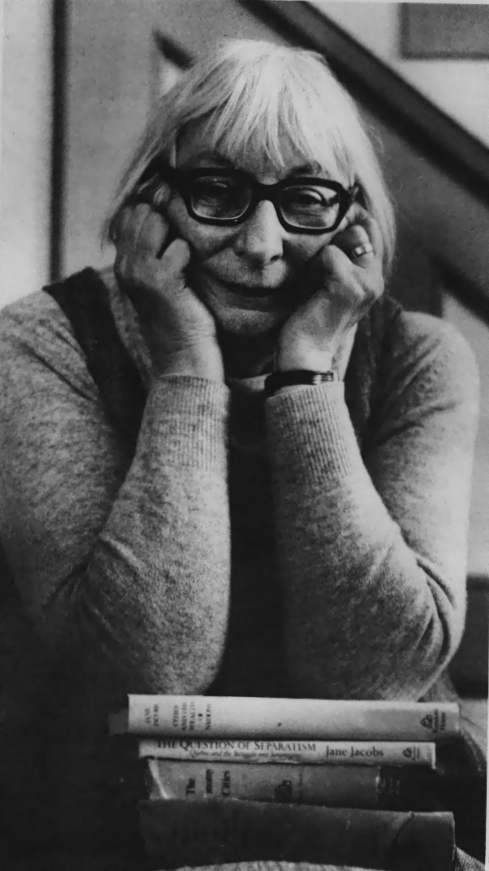 She talks about the conditions that create diversity, which she considers the great bringer of life and health to communities. Jacobs was a great admirer of spontaneity, of the casual meetings of neighbours and strangers on sidewalks and in cafes that lend great cities their ability to be hosts and midwives to the birth and growth of new ideas and fresh perspectives. For her, these things couldn't be planned, only allowed room to grow and to change and to fold over and into one another. I am learning, I guess, that the strength of a community cannot be legislated, although it can be legislated out of existence.
Walking through my now chilly south side neighbourhood, I walk past tall apartment towers mingled with low-rise condos and old, inviting homes with what my friends Norm and Joanne have called 'public rooms,' those kind of porches you can sit and have coffee on and say hello to your neighbours from, watch your kids play from, participate in the life of a street from, and I wonder how she could have known so much about what makes my neighbourhood great 45 years before this moment. She had great admiration for the role of streets in cultivating relationships, in allowing new and creative uses and experiences to emerge. I would truly have liked to have taken her around Strathcona and shown her our cafes, our restaurants, our sidewalks (and lack thereof, in places). What would she have said?
I guess it's immaterial. What makes this city great is not just the river valley, or the bridges, or the Listen birds, or the pyramids being put up and torn down. It is the people. And the people here are a strange wondrous bunch.
I'm going to get to know them better, friends.
Labels: books, cities, communities, ideas, sustainability
Wednesday, September 27, 2006
Steps
DID YOU KNOW THAT I PAINT SOMETIMES?
I've started trying to learn Persian, a heady task on top of Mandarin and bits and pieces of other things. There is an intoxication to learning a new language, especially when your conduits to it are passionate and fierce about the culture and the wisdom that come with it. I love the conventions of Persian I've picked up so far... like del, heart or belly... it's sweet, it's sincere, you have del-e-dard, you have a tummyache, you have dard in your del, you have pain in your heart.
 This painting I was working on is taken right from the English translation of the Rubaiyát of Omar Khayyám. Edmund Dulac, a French artist most famous around the beginning of the 20th century, painted it; he was, I gather, best known for his storybook illustrations. There are some amazing plates he made for an edition of the Arabian Nights you should check out, but these paintings, taken straight from Khayyám's poetry, swoon with love and beauty. What I love about Edward Fitzgerald's translations in this book is that he found things in this writing, these poems written way back in 11th-century Persia, that has a place too among the Romantic canon being swirled around in Europe at the time. The cups of wine, the dome of the sky... all these images that entranced Byron and Shelley and Keats, Fitzgerald found resonance with in Khayyám's words, and almost single-handedly brought them to the forefront of the Western imagination, albeit almost a millenium belatedly. I thank him for that.
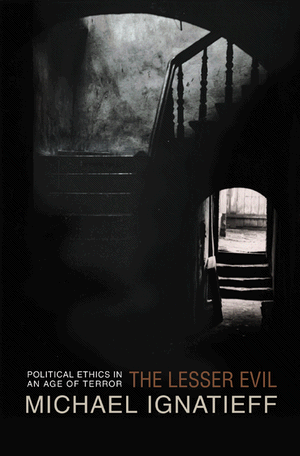 You've heard of Michael Ignatieff, right? Public academic, human rights professor, newly elected Member of Parliament for Etobicoke-Lakeshore in Toronto, current frontrunner (by a hair) for the leadership of Canada's Liberal Party, etc, etc. I've been trying to figure out just who this guy is for the past year and a half or so, ever since I read an editorial by Rex Murphy predicting his imminent return to Canada, after thirty years of travelling around the world and teaching and broadcasting, to swoop into Canadian politics and ignite new fire into the ailing Liberal Party's fortunes after former Prime Minister Paul Martin's unremarkable (and ultimately disastrous) term as chef du gouvernement canadien. I'd never even heard of him before, and was a little bit sceptical about Murphy's speculations, if you can something so eerily accurate in hindsight speculation, but lo and behold, so far the man has followed Rex's prophecising to the T.
Michael Ignatieff essentially has no profile in Canada yet, although apparently he's more well-known in Britain and the US, but he has been writing for a long time. Besides being a Massey lecturer here in Canada six years ago, he delivered the Gifford Lectures at the University of Edinburgh in 2003. It is those lectures that form the core of a book that really should have Canadians' interests piqued, The Lesser Evil. I'm only halfway through, so I won't pretend to be an expert on Ignatieff's theories here on public policy and political choices when democracies are confronted with terrorism, but it raises rather interesting questions about what he himself might do if, as Murphy mused, he becomes our PM one day.
The central debate in defining a liberal democracy, he argues, is whether its chief purpose is to serve the interests of the majority of its citizens, or whether it is to protect the rights of its most vulnerable. He is unequivocal in condemning terrorism as both an act and an ideology, but addresses what he believes to be its misjudgement in rationelle when it is employed in defense of causes that could otherwise be argued to be justifiable outrages. In cases of oppression of ethnic or linguistic minorities, he argues, use of terrorist acts may be seen as a consequence of belief that all peaceful methods of conflict resolution and addressing grievances with the state are either exhausted or non-existent.
'The logic of terrorism,' Ignatieff reasons, is aptly described as la politique du pire, the politics of the worst--'to make things worse so that they cannot become better.' Marxist revolutionaries of the nineteenth century, he argues, were the first to employ this strategy, '[understanding] that where mass popular support for revolution was lacking, the pace of change could be accelerated by acts of indiscriminate violence designed to provoke the constitutional system to "throw off the mask of bourgeois legality" and reveal itself to the peasants and workers as a system of organized violence.'
Modern use of terrorism, he says, relies on the same logic. By provoking states like the United States, Indonesia, or Sri Lanka into committing 'indiscriminate acts of oppression,' those who employ terrorism believe they can undermine their legitimacy and draw new recruits rushing into their arms. Since it will always be too strong to be defeated on equal terms of combat by a small group of individuals, the state, he argues, 'must defeat itself.' I have to admit, I had never considered this side of the coin before, so I was intrigued by his futher explanation that the chief power of terrorism is in drawing the state into a protracted and arbitrary campaign of violence and oppression on its own part, drawing it into a battle whose terms are dictated chiefly by the terrorists themselves. This, he goes on, is precisely where the 'war on terror' being conducted by the United States and its allies has gone awry.
I was somewhat dismayed to read his belief that those who believe in human rights as a trumping card for their value are doomed to be in a desperate minority. The vast majority of citizens, he argues, are more likely to value their own security over the rights of a relatively tiny minority, whose dignity and respect as instrinsic human rights may be compromised in quests for that security. That being said, he argues persuasively that 'terrorism harms democracy... primarily by making a majority of citizens believe that their liberties are a source of weakness rather than strength.' When people are unwilling even to defend their own rights and freedoms, he argues, it is laughable to suggest they would be willing, when their security seems threatened, to defend the rights of a small number of their fellow citizens who may be unjustly and abritrarily targetted in the quest for that security.
He can't be completely off the mark on that point. Beyond the crushing lack of enthusiasm for politics among your average Canadians (that I know, anyway, although I am admittedly odd in multidimensional ways), there has, I think, been an absence of sufficient furor over the detention, extradition, and torture of Maher Arar, even after his judicial vindication last month from Justice Dennis O'Connor. It is entirely possible that RCMP Commissioner Guiliano Zaccardelli was under no duress from the government to keep his mouth shut about O'Connor's report until appearing before the House National Security Committee last week, but unacceptable that, for the time beng, it appears no one will be held accountable for the serious physical and emotional trauma experienced by Arar and his family.
How do we create a culture that values rights of all of its citizens intrinsically, where injustices experienced by one are considered an affront to all? Are these ideals even worth pursuing? Last week, both the US Senate and House of Representatives passed legislation authorising President Bush's policies on detaining persons suspected of committing or being party to terrorist acts, or 'enemy combatants.' The legislative branch has, in essence, authorised the executive office's dismissal of judicial protections and freedoms for prisoners. Most alarming of the rights which have been revoked is that of habeas corpus, the right to challenge one's detention before the body responsible for one's arrest.
Let's put aside the issue of whether most--or any--of the detainees in question have any connection to terrorist groups like al Qaeda for a moment. Habeas corpus is a fundamental institution of law that prevents states from becoming party to unaccountable, arbitrary arrests and suspensions of freedoms. The nationality of the detainees is, on the one hand immaterial because of the serious affront to international law that this poses in a universal sense, but on the other hand extremely important in light of the objectives of terrorism to turn the state into the morally unethical aggressor, the oppressor: to undermine democracy's legitimacy as guarantor of freedms and protections. He qualifies this assertion by stating that 'the specific civil and political rights to be found in liberal democratic constitutions are not just a revocable privelege of citizenship, but reflect a constitutional commitment to respect the particular and equal moral status of human beings.'
 The stakes are high here, and Ignatieff is unequivocal on this point, too. He explains human rights' recent historical emergence--as crucial protections in peacetime against encroachments and injustices in times of war--as a moral response to the nightmare of the Holocaust, when popular assent for judicial suspensions of basic respect for human dignity translated into unspeakable horror for millions. Human rights, he explains, are a series of protections guaranteed to all people regardless, and especially in the case of, emergencies, to 'provide citizens with an independent moral standard that would enable them, when the law of their country went mad, to say: this may be legal, but it is not right.'
This is not to suggest I in any way endorse Ignatieff's conclusions from these assumptions, or his chances among Liberal party delegates meeting to elect a new leader in December. But this is a serious conversation Canadians should be engaged in on a public level, and considering Ignatieff's support among Liberal party members so far, I know I'm going to be spending more time figuring out what might lie ahead for a man somewhere between politician (with all its pragmatisms) and hopelessly-absorbed-academic/professor.
He writes,
'Oppression by majorities comes at little direct cost to their own liberties and rights. As Ronald Dworkin has pointed out, the trade-off is not between our liberty and our security, but between our security and their liberty, by which he means the freedoms of small suspect groups, like adult male Muslims and particular the subsect in violation of immigration regulations. These abridgements of the rights of a few are easy to justify politically when the threat of terrorism appears to endanger the many.'But one wonders about Ignatieff's own political ambitions in his explanation of the 'lesser evil' approach which forms the core of this book. While apparently committed to a person's fundamental right to protections and respect before the law, he seems willing to give ground to semi-secretive detention of terrorist suspects and methods of interrogation which may not qualify under international conventions as 'torture,' but which 'remain a violation of their dignity,' if necessity dictates employing them to serve a greater good. There is a reasonable point to be made that under an accountable, judicially mandated and temporary series of provisions, one person's rights may have to be compromised (or as he so delicately puts it, 'abridged') to save the lives of others, but one wonders how far he is willing to go.
Read The Lesser Evil. You won't regret it.
Unless you fall asleep. He's no Rohinton Mistry.
PS I got halfway through What We All Long For and I couldn't stand it. Nothing happened! I'm sure Dionne Brand is a magnificent poet, but she seems to lack any ability whatsoever to throw together a coherent plot.
Labels: books, canada, democracy, ethics, human rights, terrorism, torture
Thursday, August 17, 2006
It is a hard thing
 A grandmother remembers at this week's International AIDS Conference. (Tanja-Tiziana Burdi)
 PRIME MINISTER STEPHEN HARPER, CURRENTLY ON A TOUR of Canada's North, took a moment today in Whitehorse to address concerns about his failure to make an appearance at the week-long International AIDS Conference currently underway in Toronto. The government, he said, is being adequately represented at the conference, and added that he believed the Canadian government was committed to fighting what he called a serious health crisis; today, he announced that they would not make expected announcements on new funding for the battle against HIV and AIDS because the issue had become 'too politicised.' This should not come as a surprise from a government dragging its heels on an issue its predecessors barely feigned commitment too, especially since Prime Minister Harper still seems to believe the HIV/AIDS pandemic is primarily a health care issue.
This crisis has moved far beyond the dimensions of health care, and has become a serious social and political issue that is threatening the very fabric of social structures all over the world. India recently overtook South Africa as the country with the most number of people living with HIV, and within the next decade, India and China are expected to become increasingly major centres of the AIDS pandemic. It is, quite simply, disgraceful--and insulting--that the government of one of the richest countries in the world continues to avoid taking responsibility and leadership in this fight, and no amount of platitudes from Canadian Health Minister Tony Clement are going to negate that.
A couple of years ago, I thought I was going to volunteer somewhere in Africa with Canada World Youth. I'd been entranced by the idea of going to South Africa especially because of a movie my class had seen called The Power of One, an adaptation of an empowering book I also grew to love. I probably still exoticise the idea of going there from this moment with a choir in a prison from the movie, but it led to a book being handed to me by good family friends called Cry, the Beloved Country, by Alan Paton (and inscribed with only one word: 'Give'r!') This book has stayed with me ever since, somewhere in the back of my mind, humming, sighing, pushing me forward, and in this book about South Africa, written almost sixty years ago, one may find moments of greatness, sadness, and hope, that speak volumes about the need to take up the heavy burdens in our lives sometimes and do what is right.
The main character in the book is Zulu pastor Stephen Kumalo, a man with a quiet life and family in his town of Ndotsheni, whose simple, if not easy, life is shaken by a letter calling him to Johannesburg to come to his sister Gertrude, who has left the village a number of years ago and not been heard from since. Arriving in the city, he is amazed and taken aback in equal parts by the appalling divisions of the society he is part of; visiting the black slums on the outskirts of the city, he sees the poverty and hardship the people there are living through, and wonders why it must be so. At home, he and his wife do not have such an easy time either, and as he departs for the city, Paton beautifully observes her parting with all of their savings to allow Stephen to search for Gertrude and their son in the city; 'she sat down at his table,' Paton writes, 'and put her head on it, and was silent, with the patient suffering of black women, with the suffering of oxen, with the suffering of any that are mute.'
If you were to look for those bearing one of the heaviest burdens of the HIV/AIDS crisis across Africa, where the pandemic is still taking its greatest toll, you would not be amiss to meet the grandmothers who are left to raise the families of their children who have succumbed to it. On the opening day of the Toronto conference this week, a meeting of 'Gogo' grannies was held to introduce grandmothers from Africa raising their children's children (many of whom have contracted HIV themselves from parents) to Canadian grandmothers trying to establish international bridges and systems of support for their African counterparts. This is a truly wonderful initiative, a perfect example of international solidarity and support raising awareness of a cause and making way for concrete change. But the AIDS crisis is so large, impacting so many people in so many ways, that it is still but a small step in a number of monumental ones that must be made if we are to fulfill the slogan chosen for this week's meeting of over 20 000 delegates: Time to Deliver. Each of these delegates represents but one person for every 1500 living with HIV today.
Cry, the Beloved Country was written in 1948, a year before the white South African government formalised the policy of apartheid it continued until in the 1990s, under heavy pressure from the international community to abandon it. In this book, Paton writes passionately that the thing that kept the spirit of apartheid most alive with whites in South Africa at the time was fear; fear of losing a priveleged place in society, fear of losing power. And yet this fear caused so much damage, wrought so much pain; this is mine, that is yours, I will keep to myself and you keep to yours, and you'd bloody well stay on your side of the line. What are we afraid of when we continue to defer truly confronting this pandemic until some distant point in the future, some other time, when it will almost certainly have only grown in proportion and killed millions more? Don't give me the Tony Clement line, that Canada is doing fine, that it's the rest of the international community that must step up to the plate. Not good enough. Canada is committing $800 million the global initiative to fight HIV/AIDS? Great. But how many billions more are needed to provide anti-retrovirals, for the food it must be taken with for those who have none, and for other medicines, and to pay nurses, doctors, pharmacists, teachers, police officers whose economies have been savaged by a disease that cuts across all sectors of society? And now our government has cancelled announcements of further commitments for the entire week of the conference. Where is our moral leadership now?
Of a loss of centre, a loss of place, among the young men and women we are met with in Johannesburg, Paton writes this:
Yes, there are a hundred, and a thousand voices crying. But what does one do, when one cries this thing, and one cries another? Who knows how we shall fashion a land of peace where black outnumbers white so greatly? Some say that the earth has bounty enough for all, and that more for one does not mean less for another, that the advance of one does not mean the decline of another. They say that poor-paid labour means a poor nation, and that better-paid labour means greater markets and greater scope for industry and manufacture, And others say that this is a danger, for better-paid labour will not only buy more but will also read more, think more, ask more, and will not be content to be forever voiceless and inferior.

Of course, what he speaks of is a predominantly black country living under overwhelmingly white rule, and the injustices therein. But there are voices not being heard now, as the AIDS crisis grows. Here in Canada over 60 000 people are living with HIV; last year, the global epidemic claimed more than 3.1 million lives, of whom more than half a million were children. Fields are being left with no one to tend them, schools with no one to teach, children with no parents to raise them. This is not just a health problem anymore, and I am extraordinarily proud of high-profile members of the fight against AIDS like UN Special Envoy for HIV and AIDS in Africa Stephen Lewis and former US-president Bill Clinton for demanding lives be put before ideologies, that conditionalities on how money for HIV should be spent, such as on abstinence-only programs and not for sex workers, be scrapped. 'These conditionalities simply never work,' Lewis said yesterday. 'They are usually more destructive than they are in any way effective.'
Let us not fear to be bold, to take action, to put ourselves fully into this fight and to meet it head-on with the people living through it, for this is all of our crisis. Let our politicians put all the resources they can summon into this battle, and let the lives of the millions of people not afforded a spot on stage in Toronto beside Alicia Keys be not ruled by the whims of wealthy donors, though efforts like Bill Gates' are impressive and commendable, but let them instead be empowered to use all the resources we can gather collectively to build capacities and get the drugs they need and let us fight this thing together.
'There is a new thing happening here,' says Kumalo, of his village seeing a rebirth. 'It is not only these rains, though they too refresh the spirit. There is hope here, such as I have never seen before.' Let us carry this hope forward and show we can do more than hold press conferences and make empty promises. Let us be bold.
On another note, if you have been following events in Uganda, you may wonder why I have not written about the tentative peace talks underway between Museveni's government and the Lord's Resistance Army rebels, whose leader, Joseph Kony, has emerged from hiding for the first time in years to work out a deal. The answer is that I am simply waiting and seeing what becomes of this, I am hopeful it will lead to an end to the brutal violence in the region for the millions of people caught up in the war, but if the government keeps shooting rebel leaders and Kony and his troops are not held accountable for their atrocities... well, I am not certain what to think of all this. Write me! Let me know your thoughts on all these things.
Thank you for your patience, for your ears.
This week's photos of the International AIDS Conference were generously provided by Tanja-Tiziana Burdi, a Toronto-based photographer.
Labels: aids, books, south africa, toronto, uganda

This work is licensed under a Creative Commons Attribution-Noncommercial-Share Alike 3.0 Unported License.
aside

A blog about books, ideas, Canada (or lack thereof) and more. We've got more RPMs than a Latin American history DVD.
Previous Posts
Archive
- May 2006
- June 2006
- July 2006
- August 2006
- September 2006
- October 2006
- November 2006
- December 2006
- January 2007
- February 2007
- August 2007
- September 2007
- October 2007
- November 2007
- December 2007
- February 2008
- March 2008
- April 2008
- May 2008
- June 2008
- July 2008
- August 2008
- September 2008
- December 2008
- February 2009
- July 2009
- May 2012

Links
- Money Undressed
- Seth's Blog
- 中外对话|China Dialogue
- mental volumes with vasyL
- How to Save the World
- daveberta
- Ugandan Insomniac
- This American Life
- Life as a Vole
- Kate Beaton comics
